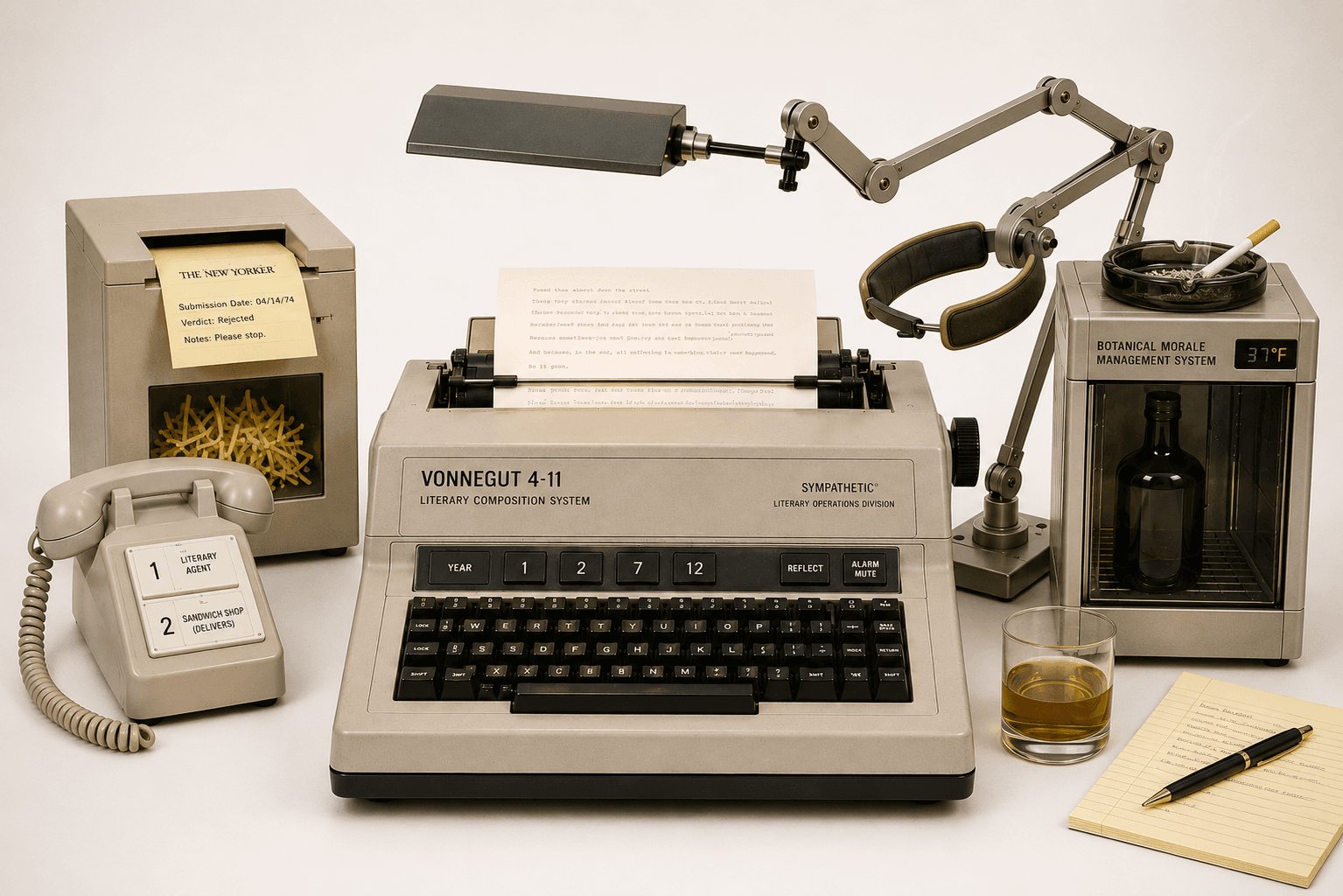
The Vonnegut 4-11 is a dedicated literary composition system engineered for the production of long-form prose under conditions of sustained cognitive and emotional load.
- Integrated Rejection Letter Disposal System
- Editorial Disappointment Alarm
- Existential Reflection Timer
- Multi-Year Project Counter
- Ashtray Stabilization Platform
- Prize Acceptance Simulation Module
- Self-Doubt Amplification Circuit
- Botanical Morale Management System
- Coil-Corded Author Communication Phone
- External Bi-Directional Hand Unit
- Literary Composition Unit
- Rejection Letter Disposal System
- Botanical Morale Management System
- Coil-Corded Communication Phone
- External Bi-Directional Hand Unit
- Task Illumination Lamp
- Operator Documentation Set
- Welcome to the Long Game (Booklet)
LETTER DISPOSAL SYSTEM
Automatically destroys unsolicited correspondence prior to operator exposure. Internal studies showed a 14% increase in daily word counts.
& PROJECT COUNTER
Prompts reflection every 45 minutes.
Tracks the passage of time without providing context.
PLATFORM
Designed to stabilize small metal objects.
Other applications are noted in field reports.
MANAGEMENT SYSTEM
Temperature-controlled botanical support system. Operator refillable. 500 mL capacity.
HAND UNIT
Maintains operator posture during extended composition sessions.
Compatible with: Chin, Forehead, Left Temple, Right Temple.
COMMUNICATION PHONE
Two preprogrammed contacts.
Setting 1: Literary Agent
Setting 2: Local Sandwich Shop (delivers)
Released in 1984, the Vonnegut 4-11 remains the best-selling machine in the history of the Literary Operations Division. Critics argued that the device encouraged unhealthy writing habits. Operators argued that it encouraged writing.
The 4-11 was developed in response to field research involving serious literary writers who reported that traditional writing environments did not adequately support the demands of long-form composition.
Early prototypes omitted the cranial support arm. Test subjects repeatedly attempted to install their own. The revision was adopted.
The Vonnegut 4-11 has been used in the production of thousands of memoirs, essays, and unfinished manuscripts.
It is not a typewriter. It is not a word processor. It is a long-term literary survival system.