Controlled Intelligence

Your organization runs AI. Who governs it?

Most organizations using AI today are doing it through tools built by someone else, running on infrastructure owned by someone else, under terms and conditions written to serve that company's interests rather than yours.

Controlled Intelligence is a different arrangement. It means your organization runs its own AI environment inside infrastructure it controls, under policies it writes, with data that never leaves its custody.

The technology is the same. What changes is who is accountable for it.
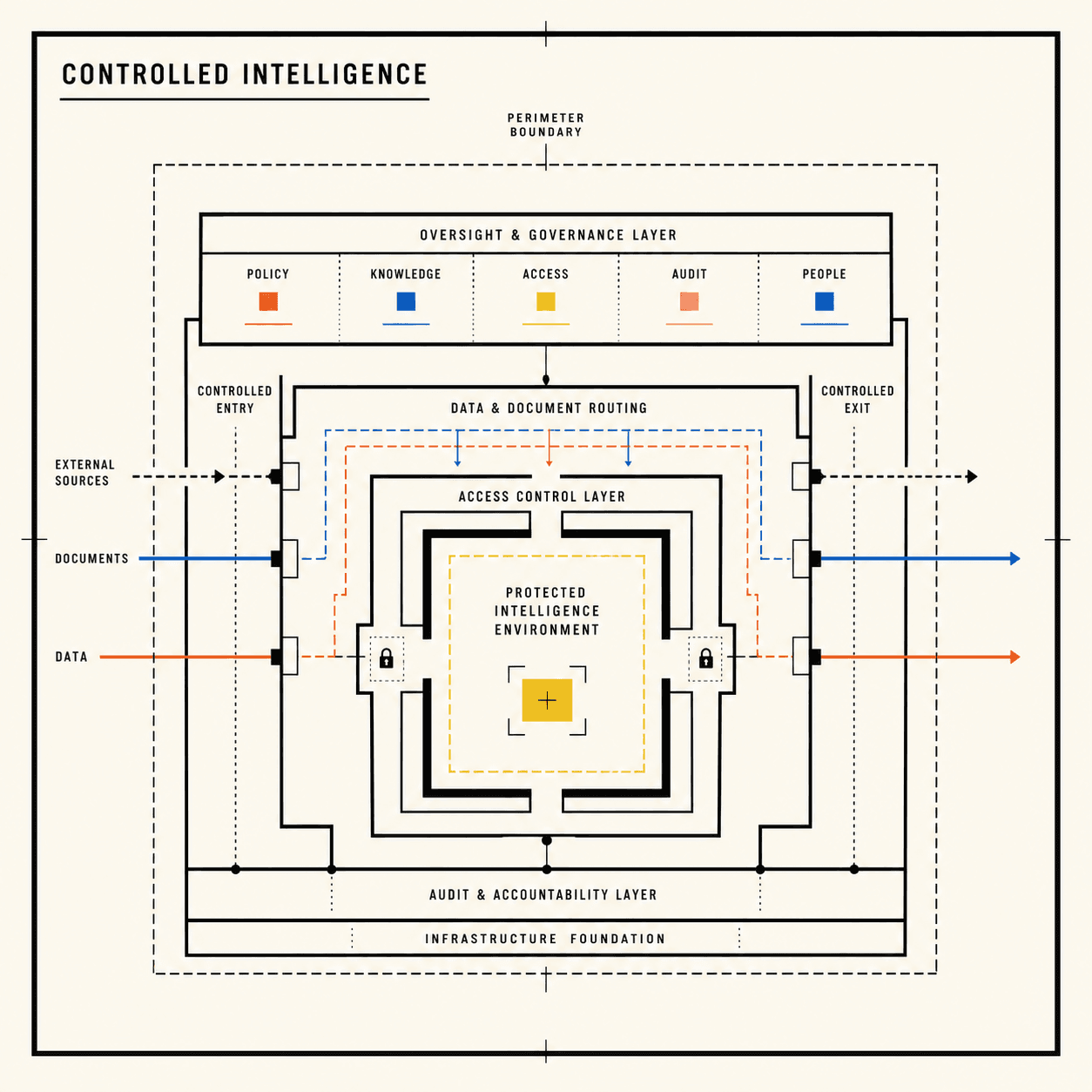
An architectural systems diagram showing governed access to a protected intelligence environment.
The point is not to make AI feel magical, but to make it integrated, predictable, and understood.
THE PROBLEM

When staff use public AI tools, the organization is not in the room.

Every time a staff member opens ChatGPT, Claude, or Gemini and types in a member's name, a policy question, a board concern, or a draft advocacy letter, that information travels to a commercial server and becomes part of a transaction the organization did not authorize and cannot audit.

Most organizations experimenting with AI right now are doing the work before they have the governance. Staff test public tools before policies exist. Sensitive information moves through platforms the organization does not control. Leaders inherit risk without a clear picture of how the tools are being used.

This is not a hypothetical. It is already happening in your organization. Controlled Intelligence gives it a boundary.

WHAT IT IS

AI that lives inside your organization, not inside a vendor's platform.

Open-weight AI models are publicly available, production-quality language models that any organization can download, host, and run on its own servers or private cloud. Models like Llama, Mistral, and Gemma are the same generation of technology as the commercial tools your staff are already using. The difference is where they run and who controls them.

In a sovereign configuration, your organization installs the model inside its own infrastructure. Staff interact with it through an interface the organization controls. Queries stay inside the system. Records stay inside the system. The model does not phone home to an external platform or train on your organization's activity.

The result is an AI environment your organization can audit, explain, and adjust. One that answers to your policies rather than a vendor's terms of service.

THE ARCHITECTURE

Four layers of governed intelligence.

01

Local Inference

The model layer

An open-weight language model runs inside infrastructure your organization governs. Prompts and responses stay inside the system boundary. No data is routed through commercial platforms or used to improve a vendor's model.

02

Retrieval-Augmented Generation

The knowledge layer

Your organization's documents, board records, policy archives, and member communications connect to the model through a controlled retrieval system. The AI works from your knowledge base, not from generalized internet training. Responses are grounded in your materials and cite them.

03

Staff Interface

The access layer

Staff interact with the system through a purpose-built interface carrying your organization's identity rather than a vendor's brand. Access controls, role permissions, and audit logging are configured to match your governance structure and existing staff responsibilities.

04

Governance Framework

The accountability layer

Policy documentation, board briefing materials, staff guidelines, and a privacy impact assessment framework travel with the technical build. The system does not go live until the governance documentation is in place. The organization can explain what it built and why.

THE COMPARISON

What changes when your organization governs the environment.

Consumer AI tools and Controlled Intelligence environments are built on similar underlying technology. The difference is structural.

MeasureConsumer AIControlled Intelligence

Where it runs

Consumer AIVendor servers

Controlled IntelligenceYour infrastructure

Who sees the prompts

Consumer AIThe platform provider

Controlled IntelligenceYour organization only

Data retention

Consumer AIGoverned by vendor's terms

Controlled IntelligenceGoverned by your policies

Training use

Consumer AIVaries by plan and terms

Controlled IntelligenceNone. Your data does not leave.

Audit capability

Consumer AINone or limited

Controlled IntelligenceFull. Every query is logged inside your system.

Staff access controls

Consumer AIAccount-level

Controlled IntelligenceRole-based, matched to your organization structure

Board accountability

Consumer AI“We use public AI tools”

Controlled Intelligence“Here is our AI policy and here is what the system does”

Regulatory exposure

Consumer AIHigh. PIPEDA/PIPA compliance is on the organization to interpret.

Controlled IntelligenceLow. Data custody stays inside the organization's control.

Cost model

Consumer AIPer-user subscriptions scaling with headcount

Controlled IntelligenceFixed infrastructure cost. No per-query or per-seat fees.

PRINCIPLES

The system follows the organization.

01

Governance before automation

Institutional judgment stays with the people accountable for the work. AI supports staff decisions. It does not replace them.

02

Local control before convenience

Sensitive knowledge stays inside boundaries the organization defines. Convenience that compromises custody is not convenience.

03

Translation before transformation

The first task is understanding how the organization already works. Technology follows those realities rather than replacing them.

04

Explainability as a governance requirement

If your board asked how your AI system works, what it has access to, and what your policies are, the answer should be immediate and complete. An organization that cannot explain its AI environment is not governing it.

THE REASON

Adoption without governance creates institutional risk.

Most organizations experimenting with AI are doing the work before they are ready. Staff test public tools before policies exist. Teams route sensitive information through platforms the organization does not control. Leaders inherit risk without a clear view of how the tools are being used.

Controlled Intelligence gives the organization a perimeter. People can investigate, draft, compare, monitor, and learn while keeping institutional knowledge inside a system the organization can audit, explain, and improve.

That perimeter is not a restriction. It is the condition that makes responsible adoption possible.

Mission-driven organizations shouldn't have to choose between progress and privacy.

Let's Talk →