Resonance
Resonance preserves continuity across the entire lifecycle of creative work. It aligns people, conversations, revisions, and memory into a persistent process that continues between interactions.
Explore the Architecture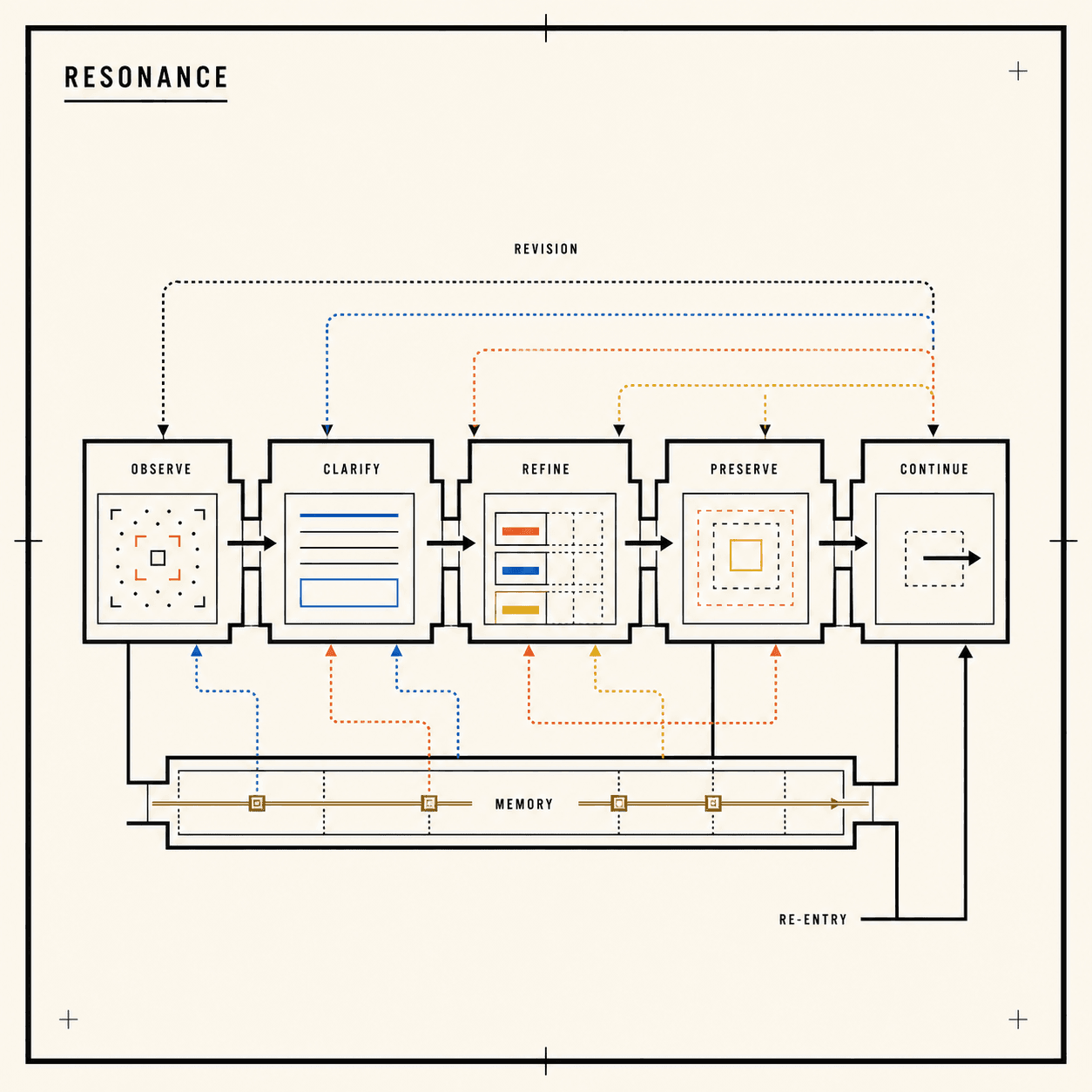
Creative work
does not happen
in meetings.
It happens
between them.
Resonance preserves
continuity across
that distance.
Capture what is actually present.
Turn observations into shared understanding.
Apply judgment through deliberate revision.
Retain the reasoning, conversations, and editorial memory.
Re-enter the work later without reconstructing context.
Resonance is not an application.
Resonance is the adaptable process architecture upon which applications such as Perkins are built. Perkins is the first implementation of Resonance.
It doesn't replace writers, editors, or the tools already in use.
It preserves continuity throughout the lifecycle of creative work, so the work keeps progressing even when people leave the room.
Resonance holds any relationship that depends on continuity: work where understanding accumulates over months, where the gap between sessions is where the real thinking happens, and where losing that thread means starting over every time.
Perkins is the first thing built on it. Other applications will be built the same way, on the same architecture, for people who need a different relationship than the one Perkins holds with a novelist and their manuscript.
Perkins Craft Analysis
Perkins is an ongoing editorial relationship between a novelist and an editor, built on the Resonance pattern.
A writer submits a manuscript and chooses what to focus on. Perkins reads what's actually on the page, not the writer's intentions, and returns an editorial letter: a diagnosis in the writer's own terms. The writer takes that back to the draft and writes the next scene themselves.
What happens between sessions is what makes this a Resonance application. The reasoning behind each editorial letter persists: the writer can leave for three weeks and come back to a desk that remembers the conversation, without the manuscript itself ever being stored. The relationship deepens. The manuscript stays the writer's own.
What comes next
The same architecture holds other kinds of work: a research collaborator that keeps the state of a literature review intact across a year of stop-and-start reading, a policy advisor for an association that remembers the reasoning behind a decision after the staff who made it have moved on. Perkins proves the pattern works for one relationship. What we build next proves it wasn't a coincidence.
Principles
Continuity, not automation.
The work carries forward. Nothing about it runs itself.
Clarity, not creativity.
It gives people a clearer view of their own work over time.
Architecture, not application.
Perkins is one implementation. The pattern beneath it is what Resonance names.
Presence, not productivity.
Continuity exists so creative work keeps its shape between the moments people are actually in the room.
About
Resonance is developed by Sympathetic Technology, a Vancouver-based research, systems, and publishing practice.